
UK CAFE PROCUREMENT GUIDE
Coffee Shop Supplies UK: 10 Best Suppliers for 2026
Coffee shop supplies UK buyers need are not all best sourced from the same type of business. A start-up café may require an espresso machine, grinder, beans and training from one specialist. A busy multi-site operator may care more about consolidated food deliveries, dependable stock and account management. A takeaway-led brand may need tight control over cup sizes, lid fit and custom printing.
Editorial disclosure: This guide compares ten established options across those different needs. Inclusion is based on the product and service information published on each supplier’s website and reviewed on 30 July 2026. It is an editorial shortlist, not a product test, paid ranking or claim that every supplier serves every UK postcode.
Before opening an account, request current prices, minimum orders, delivery coverage, lead times, contract terms and samples. For coffee, arrange a tasting. For equipment, confirm service response and parts support. For cups and lids, test the exact production combination with the drinks you sell.
Coffee Shop Supplies UK: Quick Supplier Comparison
| Supplier | Best suited to | Main published offer | What to verify |
|---|---|---|---|
| Brakes | Cafés consolidating food, drink and catering lines | Coffee inputs, bakery, food, packaging and equipment access | Depot range, delivery schedule and account terms |
| Bidfood | Operators wanting coffee support within broad foodservice supply | Coffee brands, equipment advice, training and supporting products | Local availability, equipment agreement and support scope |
| Matthew Algie | Coffee-led cafés prioritising training and ongoing support | Coffee, machines, café supplies and barista training | Coffee programme, machine terms and engineer coverage |
| Liquidline | Equipment-led and coffee-to-go projects | Machines, consumables, installation and servicing | Machine capacity, finance terms and response times |
| ADS Coffee Supplies | One-account equipment and consumables purchasing | Machines, beans, syrups, disposables, cleaning and service | Current delivery thresholds, lease details and local service |
| Nisbets | Equipment, smallwares and operational supplies | Machines, crockery, disposables, syrups and café clothing | Stock, warranty route and suitability for heavy use |
| Caffe Society | Online buying across coffee and café essentials | Beans, cups, lids, cleaning products and accessories | Current bulk discounts, compatibility and delivery |
| Iron & Fire | Independent cafés seeking coffee plus menu ingredients | Beans, equipment, syrups, tea, chocolate and training | Trade prices, delivery terms and equipment support |
| Café Deli Wholesale | London-area cafés buying ambient menu lines | Coffee, tea, cocoa and syrups | Delivery area, minimum order and full category range |
| Doppio Coffee Warehouse | London buyers wanting a showroom and training | Beans, commercial equipment and wholesale training | Coverage outside London, service terms and stock |
How This Coffee Shop Supplies List Was Selected
This coffee shop supplies list favours businesses with a public trade offer relevant to a working café. It covers broadline foodservice wholesalers, coffee specialists, equipment-led providers and operational-supply distributors. The evaluation considers:
- breadth and relevance of the published range;
- coffee-machine, maintenance or training support where offered;
- food, drink, consumables and takeaway-service coverage;
- apparent suitability for independent, multi-site or specialist operators;
- clarity of trade ordering information; and
- the buyer’s ability to verify details directly.
No single score would be useful for every café. The entries are therefore organised by procurement use case, not from “best” to “worst”.

What Supplies Do You Need for a Coffee Shop?
A practical coffee shop supplies list should follow the menu, service model and forecast demand. Buying every available product at launch ties up cash and storage space, while missing a critical cleaning or packaging component can stop service.
| Supply category | Typical supplies needed for a coffee shop | Best-fit supplier type |
|---|---|---|
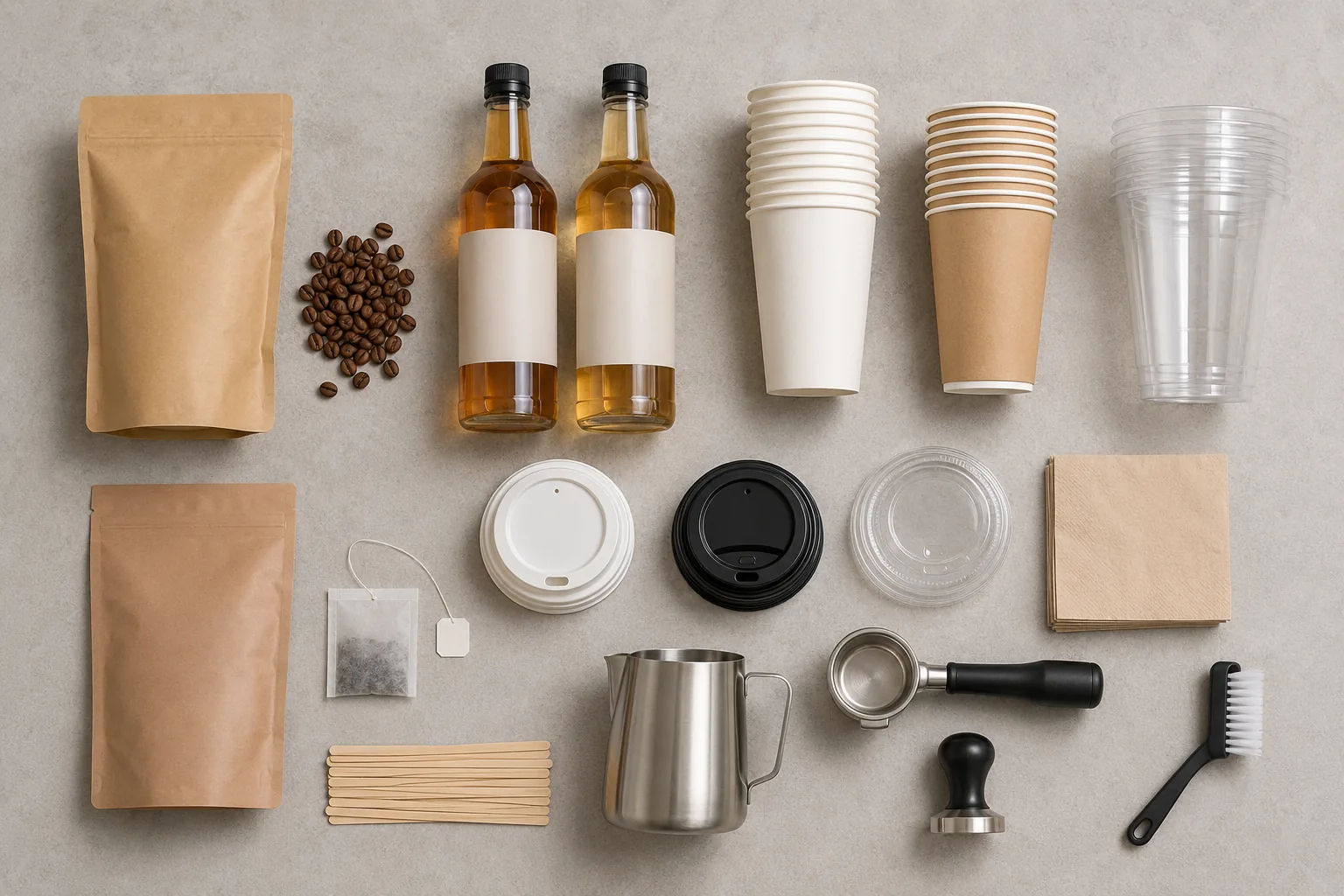
| Coffee and drink ingredients | Espresso beans, filter coffee, decaf, tea, chocolate, syrups and selected alternative drinks | Coffee specialist or beverage wholesaler |
| Coffee shop supplies and equipment | Espresso machine, grinder, brewer, water treatment, refrigeration and smallwares | Equipment specialist with installation and service support |
| Food and bakery | Pastries, cakes, brunch ingredients, sandwiches and retail snacks | Broadline foodservice distributor or specialist bakery supplier |
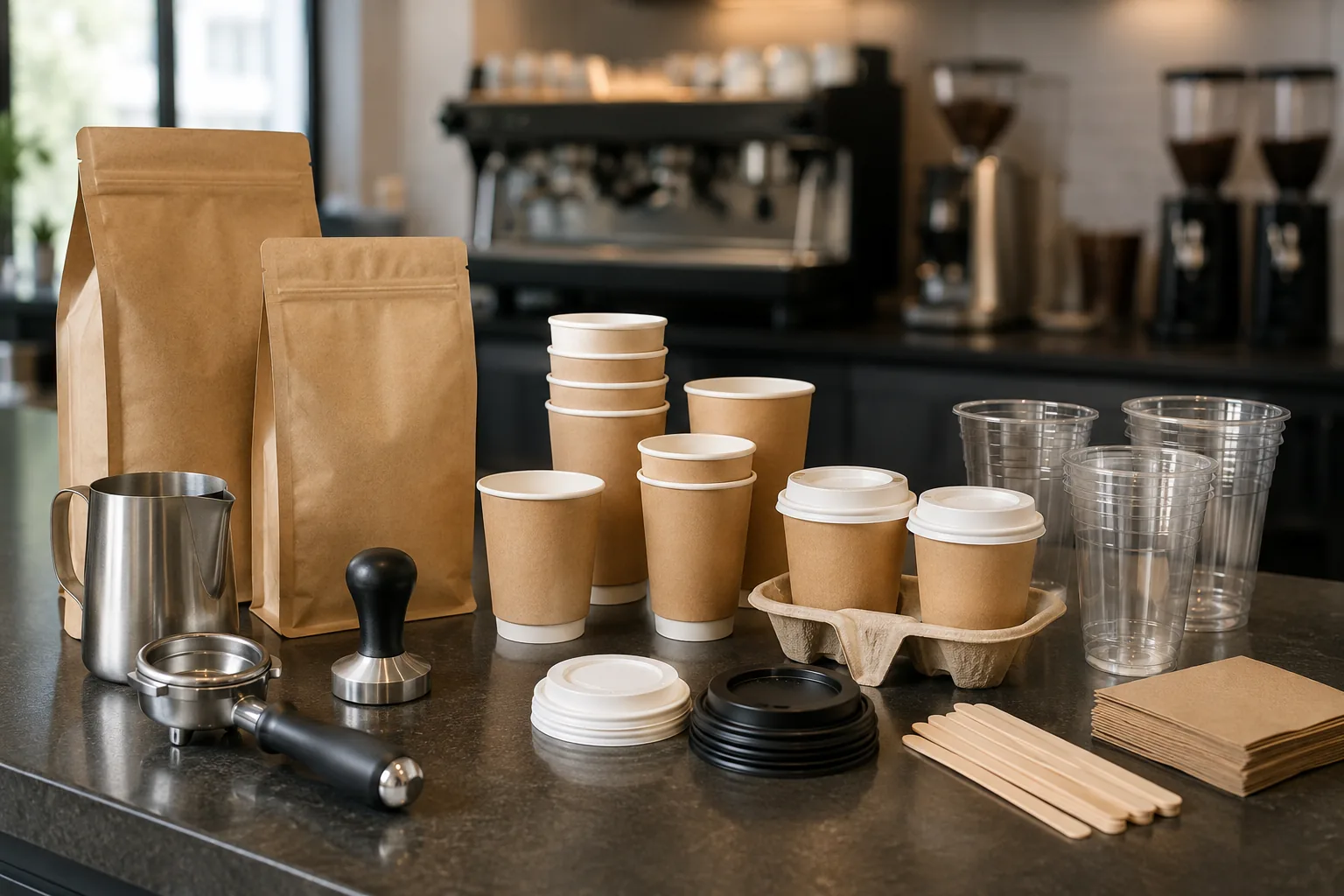
| Disposable coffee shop supplies | Hot cups, cold cups, compatible lids, sleeves, stirrers, napkins and cup carriers | Foodservice wholesaler or packaging manufacturer |
| Cleaning and maintenance | Machine cleaner, milk-system cleaner, brushes, cloths, bins and approved chemicals | Equipment partner or catering-supplies distributor |
| Front of house | Crockery, trays, glassware, cutlery, uniforms, menu holders and display items | Catering-equipment or hospitality-supplies distributor |
| Operational stock | Till rolls, labels, storage containers and basic safety supplies | General hospitality wholesaler |
Use this list to create a weekly consumption forecast and a separate opening-equipment budget. Ask each coffee shop supplier which items it stocks directly, which are ordered from a partner and which carry long lead times.
2. Bidfood: Best for Coffee Support Within Foodservice Supply
Bidfood Coffee Your Way combines coffee brands with specialist advice, training and equipment support. Its equipment programme covers traditional espresso, bean-to-cup, filter and coffee-to-go formats through its published supplier partnership.
This makes Bidfood worth considering when coffee is one part of a larger hospitality purchasing programme. A restaurant, hotel, contract caterer or multi-category café may value the ability to discuss equipment and ongoing coffee supply alongside foodservice ordering.
Clarify who owns the equipment relationship, who responds to breakdowns, what training is included and whether consumable purchases are tied to the machine agreement.
3. Matthew Algie: Best for a Training-Led Coffee Programme
Matthew Algie publishes an integrated offer covering coffee, commercial machines, café supplies and barista training across the UK and Ireland. Its café service also emphasises installation, ongoing technical support and training for café teams.
This model can suit an operator who wants to build drink consistency around a defined coffee programme rather than purchase beans as a standalone commodity. Training is particularly relevant when a café has new staff, multiple shifts or several sites that must follow the same recipes.
Taste the proposed coffee with your water, milk and target menu. Confirm training availability, engineer coverage, machine ownership or finance terms, preventive maintenance and what happens if the relationship ends.
4. Liquidline: Best for Equipment-Led and Self-Service Projects
Liquidline supplies commercial coffee, water, vending and juice equipment along with ingredients, consumables, installation and servicing. Its coffee-to-go offer includes traditional and bean-to-cup formats and ongoing replenishment options.
It can be a strong candidate where machine selection and uptime lead the decision—for example, a high-volume café, convenience format, workplace concession or self-service station.
Do not select a machine from drink count alone. Share peak 15-minute demand, menu complexity, available power, plumbing, counter dimensions and cleaning capacity. Request a written service-level description and confirm whether emergency labour, parts and loan equipment are included.
5. ADS Coffee Supplies: Best for One-Account Equipment and Consumables
ADS Coffee Supplies lists espresso and bean-to-cup machines, grinders, beans, syrups, hot chocolate, disposables, cleaning supplies, equipment leasing, training and servicing for trade customers.
This combination can work for an independent café or small group seeking one point of contact for day-to-day beverage supplies and equipment support. Its online trade proposition is unusually detailed, which helps buyers form a useful first set of questions.
Published thresholds, dispatch targets and service claims can change. Confirm them for your postcode and account. Also ask whether standing orders can be adjusted seasonally and how urgent replacement stock is handled.
6. Nisbets: Best for Equipment, Smallwares and Front-of-House Basics
Nisbets presents a coffee-shop range spanning machines, crockery, disposables, syrups, clothing and broader catering equipment. This is useful when a new site needs practical items such as jugs, tampers, knock boxes, trays, bins, storage, cleaning tools and tableware as well as headline equipment.
Nisbets may be more useful as an operational-supplies partner than as the sole owner of a café’s coffee programme. Buyers can use it to fill gaps and compare equipment specifications across a broad catalogue.
Check whether warranty and repairs are handled directly or by a manufacturer, and confirm that any machine is rated for your expected commercial workload. For lids and cups, never assume two products fit because their nominal diameter looks similar.
7. Caffe Society: Best for Online Reordering Across Café Essentials
Caffe Society’s Café Range includes coffee beans, disposable takeaway cups, lids, hot chocolate and machine-cleaning products. Its wider accessory range covers barista tools, trays, stirrers, napkins and tableware.
The online catalogue may suit buyers who prefer to compare products and reorder without a fully managed supply agreement. It can also be useful for an independent operator topping up several categories in one basket.
Compare the delivered cost after VAT, shipping and any spend threshold. Match cleaning chemicals to the equipment manufacturer’s instructions, and obtain cup and lid samples before ordering cases.
8. Iron & Fire: Best for Independent Cafés Adding Drink Variety
Iron & Fire positions itself as a coffee-shop supplier covering beans, machines, equipment, training, syrups, speciality tea, hot chocolate and cleaning products.
That mix can help independent cafés build a broader hot-drink menu around one coffee relationship. Syrups, chocolate and tea are commercially important, but the range should still be tested against service speed, storage space and realistic weekly demand.
Open a trade discussion to obtain current pricing and delivery terms. Ask for coffee samples, recipe costs and guidance on equipment support. Avoid adding too many slow-moving flavours simply because the catalogue is broad.
9. Café Deli Wholesale: Best for Locally Focused London Ordering
Café Deli Wholesale lists coffee, tea, cocoa, powders and syrups and describes a locally based, tailored service with next-day delivery.
A locally focused wholesaler can be valuable when personal account support and frequent ambient-goods delivery matter more than a national network. London operators may want to compare its range with national broadline suppliers and specialist coffee partners.
Online pricing requires registration. Confirm the delivery boundary, order minimum, cut-off time, return policy and whether chilled food, disposables or emergency top-ups are available for your location.
10. Doppio Coffee Warehouse: Best for London Showroom Access
Doppio Coffee Warehouse offers wholesale customers coffee beans, commercial equipment and barista training. Its site also invites buyers to visit a showroom and compare multiple bean brands and blends.
Physical evaluation is useful for a start-up deciding how a grinder, espresso machine and bar layout work together. A tasting can also reveal whether a coffee remains balanced in the milk-based drinks that dominate the planned menu.
Confirm delivery and engineering coverage for the actual site, especially outside London. Request written equipment specifications, warranty terms, installation requirements and a training plan before committing.
How to Choose Wholesale Coffee Shop Supplies
Searches for coffee shop supplies wholesale often mix broadline distributors, coffee specialists and equipment-led providers. Compare each offer against the same operating brief before opening an account.
Start with the operating model
Write down expected drinks per day, peak-hour orders, food mix, takeaway share, storage capacity and number of sites. A 40-seat brunch café needs a different supply model from a kiosk serving mostly takeaway flat whites.
Compare landed cost, not one unit price
Include delivery charges, minimum orders, VAT treatment, waste, case quantities, equipment finance, filters, cleaning chemicals and staff time. A cheaper cup that causes lid failures or a low-cost machine with slow repair coverage can raise the real cost of service.
Separate taste approval from commercial approval
Blind-taste espresso and milk drinks, but also calculate dose cost, extraction consistency and training needs. Then assess commercial terms, account support and supply continuity.
Put service expectations in writing
For equipment, record planned maintenance, emergency response, parts, exclusions, loan-machine policy and escalation contacts. For consumables, record order cut-offs, normal lead times, substitution rules and out-of-stock communication.
Test packaging as a complete system
A takeaway drink package is not just a cup. It includes the cup, lid, sleeve where needed, straw or stirrer, carrier and outer case. Test the exact combination before approving volume production.
Disposable Coffee Shop Supplies and Packaging Checklist
Packaging deserves its own specification even when beans, food and equipment come from a broadline supplier.
| Service need | Practical packaging option | Compatibility check |
|---|---|---|
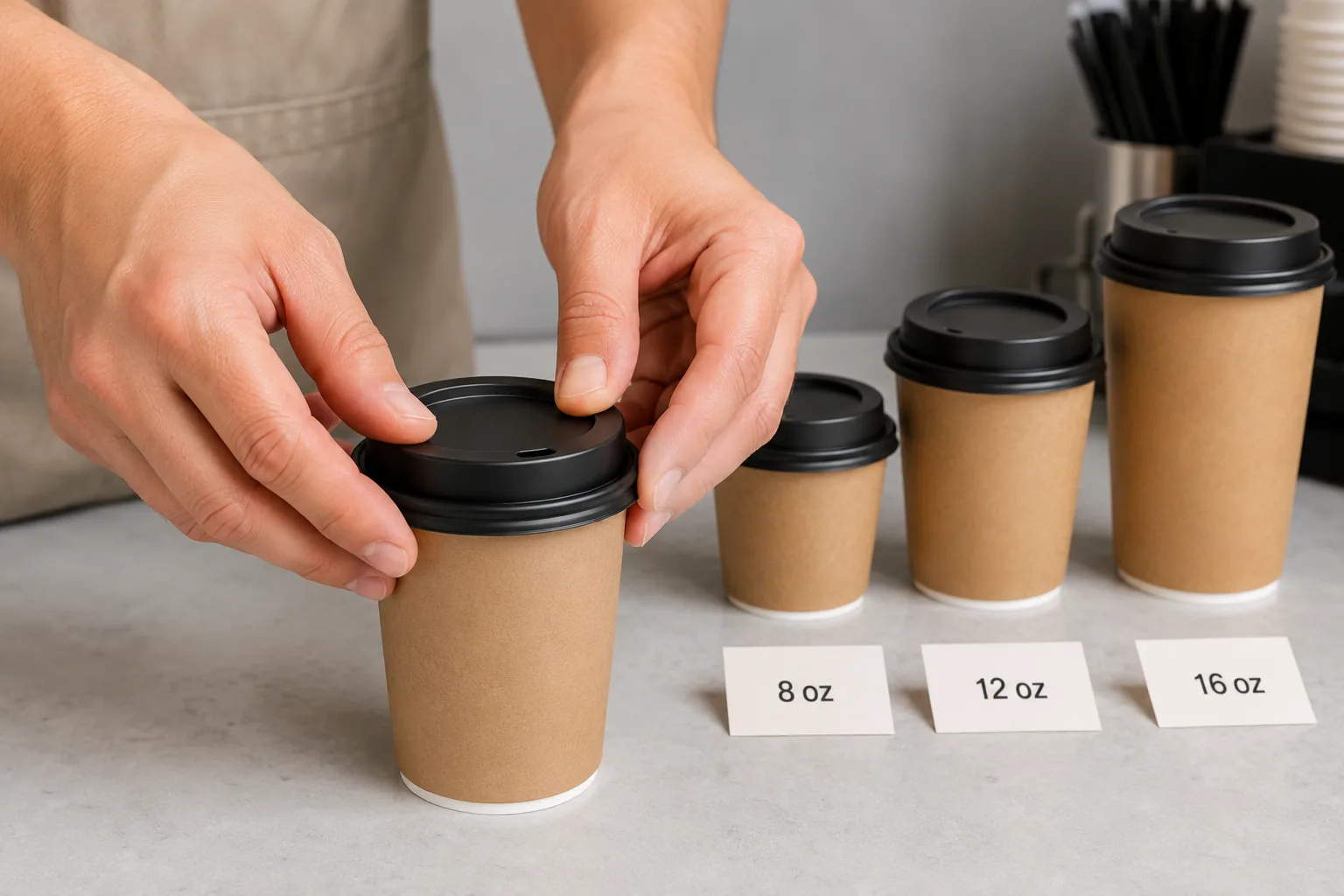
| Espresso and small hot drinks | 4 oz paper cup with matching lid where takeaway is offered | Rim diameter, fill level and lid retention |
| Flat white and regular hot coffee | 8 oz or 12 oz hot paper cup | Heat handling, lid fit and machine clearance |
| Large latte or tea | 12 oz or 16 oz hot paper cup | Cup height, lid fit and carrier stability |
| Iced coffee | Clear PET cup with flat or dome lid | Cup material, lid series, straw opening and cold-use suitability |
| Smoothie or cold speciality drink | PET or PP cup selected for the recipe and service method | Diameter, sealing method, dome clearance and local requirements |
| Multi-cup takeaway order | Two-cup or four-cup carrier | Loaded balance, cup-base fit and moisture resistance |
| Branded service | Custom printed cups or sleeves | Artwork area, colour proof, MOQ, lead time and case packing |
Ask the packaging supplier to confirm cup-and-lid compatibility by product code, not just by an “8 oz” or “90 mm” description. Review the available cup lid options as matched components rather than interchangeable accessories, because nominal dimensions do not guarantee a secure fit across different manufacturers.
For custom printed cups, request a physical sample or production-representative proof, approved artwork specifications, colour tolerances, case quantities and a written delivery schedule. Material and compliance options should be chosen according to the beverage, target market and applicable local requirements.
Where Do Coffee Shops Get Their Supplies?
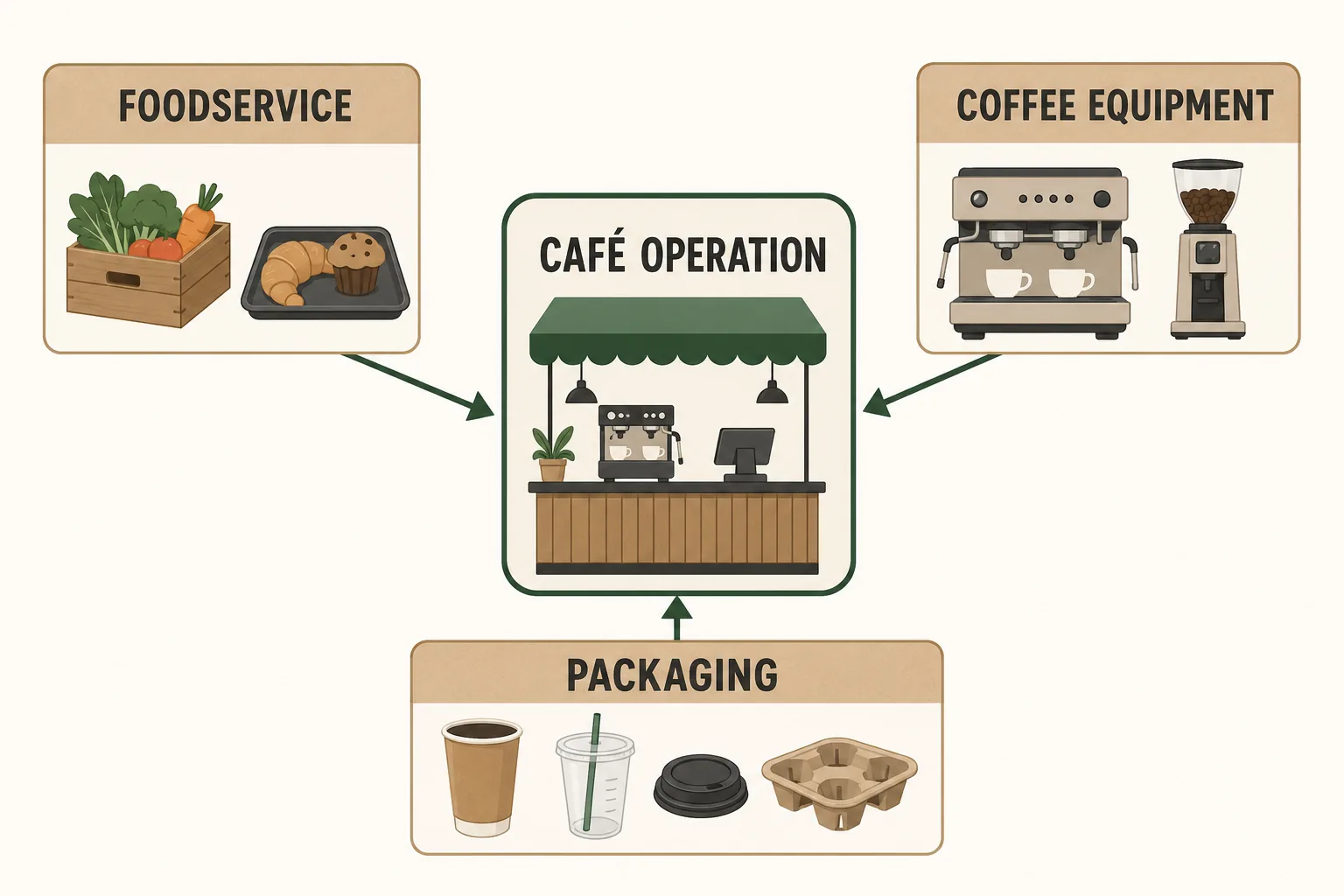
Coffee shops commonly buy from coffee roasters, equipment specialists, broadline foodservice distributors, local wholesalers and packaging manufacturers. One broad supplier can reduce purchase orders, deliveries and invoice handling. It may be the right base for food, ambient ingredients and routine commercial coffee shop supplies.
Specialist partners can add depth. A coffee roaster may provide better training and recipe support; an equipment specialist may provide stronger engineering coverage; a packaging manufacturer may offer more control over cup construction, lid compatibility and custom printing.
Many cafés therefore source bulk coffee shop supplies through a hybrid model:
- a primary foodservice wholesaler for broad weekly orders;
- a coffee and equipment partner for drink quality and uptime; and
- a packaging partner for cups, lids, carriers and branded supply.
Maintain an approved backup for critical, fast-moving items. Before switching products during a shortage, test compatibility and update staff instructions.
Questions to Ask Every Supplier
- Which postcodes do you serve, on which days, and with what order cut-off?
- What are the minimum order, delivery charge and trade-account requirements?
- Which core products are normally stocked, and how are substitutions approved?
- Can you provide samples, specifications and allergen information where relevant?
- Who handles equipment installation, warranty, servicing and emergency breakdowns?
- Are training and refresher sessions included or charged separately?
- Can prices change during the agreement, and how much notice is provided?
- What are the return, damaged-goods and credit procedures?
- Can cup and lid compatibility be confirmed by exact product code?
- What are the MOQ, artwork, proofing and lead-time rules for custom packaging?
FAQ
Who is the best coffee shop supplier in the UK?
There is no universal winner. Brakes and Bidfood suit broad foodservice consolidation; Matthew Algie, Liquidline, ADS, Doppio and Iron & Fire offer different coffee or equipment strengths; Nisbets and Caffe Society cover practical supplies; locally focused wholesalers may suit specific delivery areas.
Can one supplier provide everything for a coffee shop?
Some broadline and specialist suppliers cover many categories, but “everything” rarely means equal depth in food, beans, engineering, training and custom packaging. Compare a one-supplier model with a hybrid of foodservice, coffee-equipment and packaging partners.
What should a new café buy first?
Define the menu and peak demand before ordering. Then specify the espresso or brewing system, grinder, water treatment, refrigeration, smallwares, cleaning products, beans, milk, ingredients, tableware and a tested takeaway packaging system.
How should I compare wholesale café supply quotes?
Compare annual landed cost, not only item prices. Include delivery, minimum orders, case sizes, waste, equipment finance, maintenance, training, stock reliability and the administrative cost of managing each supplier.
How do I check whether coffee cups and lids fit?
Request matched product codes and physical samples. Fill the cup with the intended drink, apply the lid as staff would, and test retention, sipping, transport, stacking and carrier fit. Never approve bulk supply from nominal diameter alone.
Should a café use custom printed cups?
Custom cups can improve brand consistency when volume, artwork and storage make the project practical. Confirm print area, colour proof, MOQ, production lead time, lid compatibility and case packing before ordering.
PAPER CUP BULL
Need a Bulk Coffee Cup and Lid Supply Plan?
PaperBull supplies hot paper cups, cold PET cups, lids, cup carriers and custom printed packaging for cafes, coffee chains, foodservice operators and distributors.
Send your drink menu, target cup sizes, expected order volume, destination market and artwork needs to discuss a practical packaging solution.