
PaperBull · Espresso Cup Guide
Double Espresso Cup Size: Choosing Between 3 oz and 4 oz
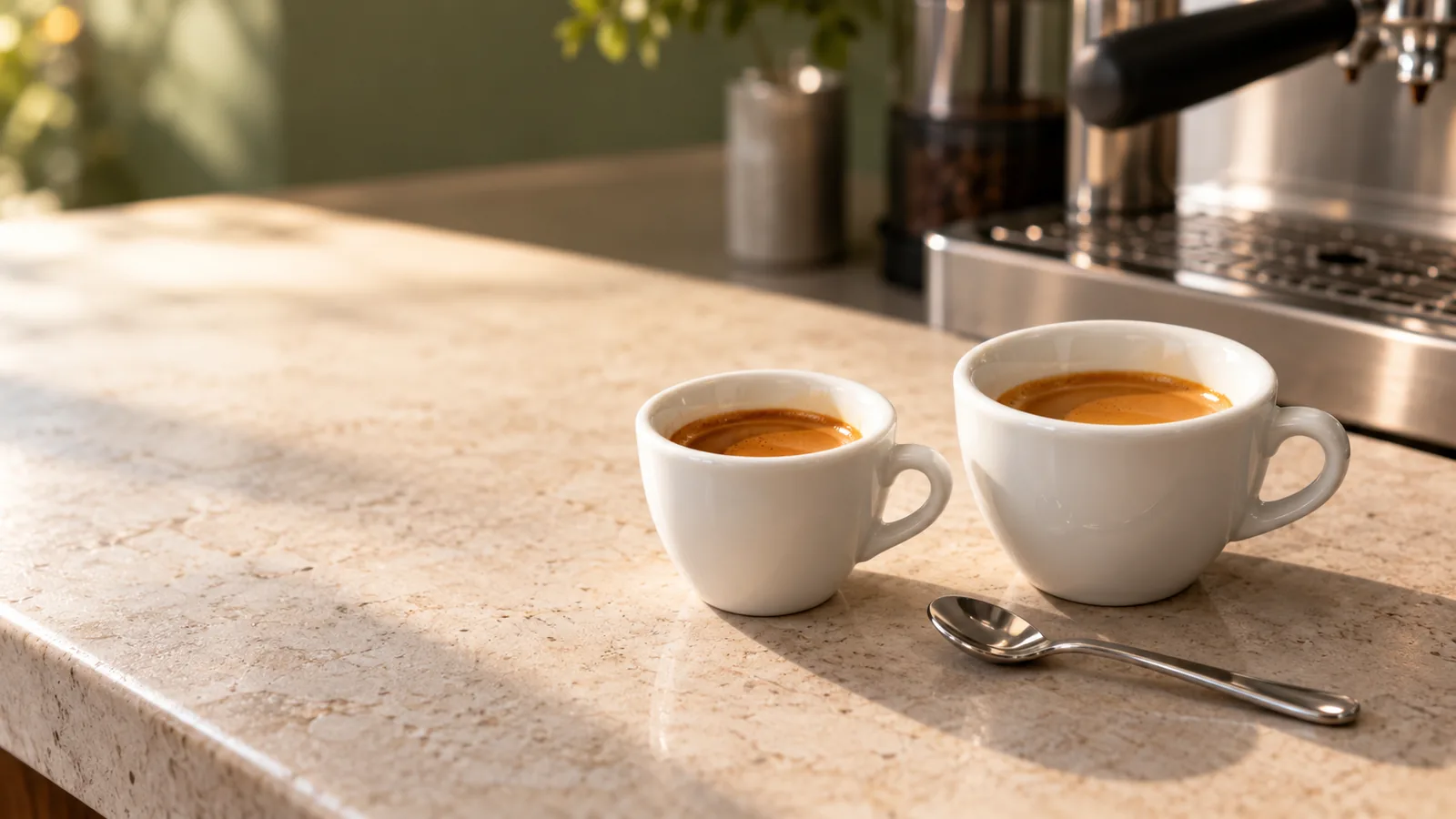
For a double espresso cup size, start by comparing a 3–4 US fl oz cup, roughly 90–120 mL. A 3 oz cup can suit a shorter straight double; a 4 oz candidate gives more capacity to evaluate when your recipe, crema, additions or takeaway service need it. Neither size is an automatic fit for every machine or drink.
The important distinction is between the espresso you brew and the cup that holds it. A drink setting, a recipe weight and a cup's capacity describe different things. Choose the vessel after checking your actual finished drink, not just the word “double.”
What Double Espresso Cup Size Should You Start With?
Compare a compact espresso cup with the next larger option. For a real vessel reference, notNeutral lists its Lino espresso cup at 3 oz / 89 mL. That establishes one product's stated volume; it does not prove that every double espresso will fit every 3 oz cup.
Use this table to choose samples, then confirm the fit with your own recipe.
| Your service | First comparison | What decides the choice |
|---|---|---|
| Straight double served immediately | Start with a 3 oz candidate | Coffee and crema remain comfortably below the rim during normal handling |
| Longer output or a visibly fuller extraction | Compare 3 oz and 4 oz | Actual filled height, rather than the drink name alone |
| Double with a little milk or other additions | Include a 4 oz candidate or larger if needed | The complete drink must fit, including the space needed to stir |
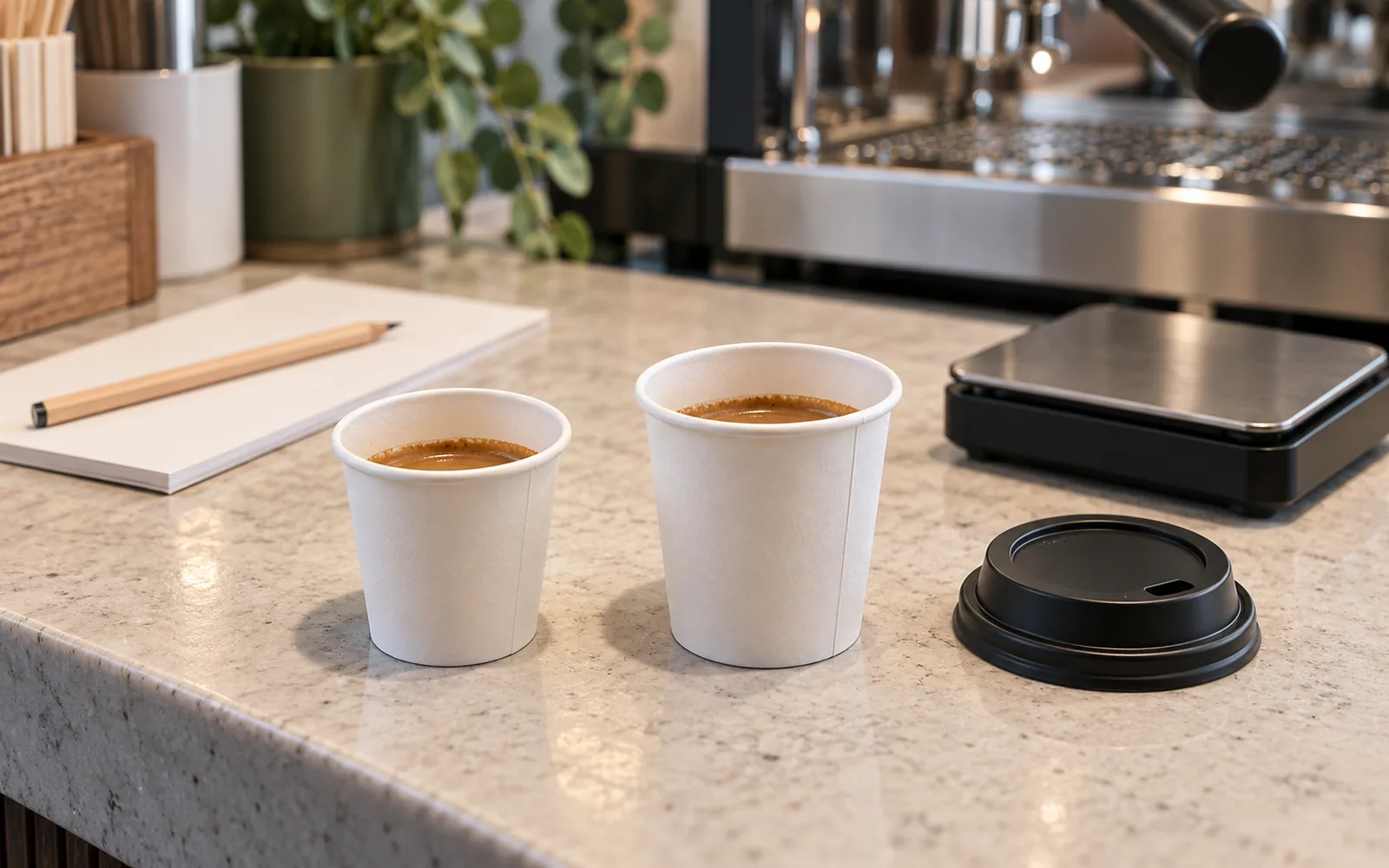
| Double espresso to go | Compare appropriately specified hot-drink cups | Approved fill with the exact lid fitted, plus practical handover |
| Office or hotel capsule station | Start from each enabled machine setting | All intended drinks must fit the selected cup, not just the smallest setting |
These are sample-selection suggestions, not universal serving standards or a list of available PaperBull SKUs. There is no need to move up in size if the smaller candidate works well in your service. Equally, a cup should not be filled to its rim merely to preserve a preferred size label.
The Double Shot and the Cup Are Different Measurements
A double shot espresso cup size cannot be selected from the coffee dose alone. Keep these three measurements separate:
- Dose: the mass of dry ground coffee used for extraction.
- Yield: the amount of espresso collected, often controlled by weight.
- Cup capacity: the space available in the vessel, stated or measured by volume.
La Marzocco's espresso guidance uses 18 g of coffee producing 36 g of espresso as an example of a 1:2 starting ratio. That is a recipe expressed by mass. It does not mean the serving cup should hold 36 mL, nor that every double must use this recipe.
For cup selection, keep the approved recipe unchanged and observe the finished drink in the candidate vessel. Include the crema and anything added before handover. This checks a different question from whether the extraction reached its target weight.
Why One Machine Says 60 mL and Another Says 80 mL
The Breville Bambino BES450 instruction book describes a preset double espresso of approximately 60 mL. It also explains how the programmed volume can be changed.
The Nespresso Vertuo manual lists double espresso at 80 mL. This is a setting for that system, not a universal definition of a café double.
Check the machine and settings actually in use. A supplier brief that says only “double espresso cup” leaves this important difference unresolved.
Double Espresso Cup Size in mL and US fl oz
The following figures convert volume units. They do not measure the usable fill of any particular cup.
| Volume in US fl oz | Calculated volume in mL, rounded | How to use the number |
|---|---|---|
| 2 | 59.1 | A reference for volume, not a default double-espresso vessel recommendation |
| 3 | 88.7 | Compare with the supplier's actual small-cup specification |
| 4 | 118.3 | Compare a larger candidate when the finished drink needs more room |
| 5 | 147.9 | Consider only if your complete drink and service justify the extra capacity |
Calculations use the US fluid-ounce factor in NIST's conversion table. Product descriptions often round these values. An item marketed as “4 oz / 120 mL” still needs its actual capacity and fill guidance confirmed. Imperial fluid ounces are a different unit.
A Simple Headroom Example
Suppose a cup has a measured brimful capacity of 90 mL. For illustration only, a 60 mL fill leaves an arithmetic difference of 30 mL; an 80 mL fill leaves just 10 mL.
Those differences are not automatically usable service margins. The method used to measure the drink, its crema, added ingredients, stirring and the lid can change the practical result. These are hypothetical figures, not measurements of the named products or a prescribed headroom allowance.
This is why a nominally matching capacity is not enough. Check the filled sample during the steps staff actually perform. If it is awkward to stir, lift or close, compare another size or cup shape rather than treating the ounce label as approval.
Choosing a Takeaway Cup for a Double Espresso
For takeaway service, start with a cup intended for the hot drink and the way it will be carried. A small dessert container with a similar ounce label is not automatically a suitable substitute.
Ask for samples from the hot paper cup range and confirm whether the required small format is available. Use the following selection table when comparing proposals.
| Candidate | Appropriate next step | Detail to confirm before ordering |
|---|---|---|
| Compact hot-drink paper cup | Trial the straight double without changing the recipe | Actual capacity, intended hot-use conditions and filled presentation |
| Larger hot-drink paper cup | Trial the longer output or complete drink with additions | Working fill, ease of handling and machine clearance |
| Cup supplied with a lid | Test the assembled cup and lid | Exact paired SKUs, fit and room below the lid at the approved fill |
| Custom-printed version of an approved cup | Review a sample using the intended construction and artwork | Final drawing, print area, order quantity, packing and commercial terms |
These are purchasing routes, not verified stock listings. No small-cup size, MOQ or matching lid is implied by this table.
When a lid is required, use the cup lid range as a starting point for discussion, then obtain the supplier's exact pairing. Two cups with the same stated volume need not have the same rim.
Finally, place the sample on the machine's normal tray or scale. Check that it fits under the outlet and can be removed without tilting unnecessarily. Capacity alone does not describe height or width.
What to Record During a Sample Trial
A short comparison is more useful than selecting a cup from a photograph. Record:
- The machine, selected setting or café recipe, and any additions.
- The candidate cup reference and how its stated capacity was defined.
- The filled appearance immediately after preparation and at handover.
- Whether stirring, lifting and any lid application work as intended.
- The selected cup-and-lid references, or the reason another sample is needed.
Repeat the comparison if the recipe or packaging changes. This is a proposed practical selection check, not a laboratory test or a substitute for the supplier's relevant product documentation.
Frequently Asked Questions
What size cup for double espresso should I buy?
Compare 3–4 US fl oz candidates, roughly 90–120 mL. Start with the smaller option for a shorter straight double and compare the larger one when your actual drink or service needs more space. Confirm the filled sample before buying in quantity.
Is a 2 oz cup large enough for a double espresso?
Do not assume so. Two US fluid ounces convert to about 59.1 mL. If the drink occupies around that much space, a cup with that actual brimful capacity would leave little or no room for handling. Check the specific recipe and vessel rather than relying on the label.
Is a 4 oz cup too big for a double espresso?
Not necessarily. It is a useful comparison candidate for a longer output, additions or takeaway service. A shorter straight double may look more appropriate in a smaller cup. Test presentation and handling rather than assuming one size is always better.
Does a 36 g espresso yield mean I need a 36 mL cup?
No. Grams measure mass and milliliters measure volume. Keep recipe yield and vessel capacity separate, then check the finished drink and crema in the proposed cup.
Can I use the same cup for single and double espresso?
Possibly, if both drinks work in that cup. Test the larger fill and the presentation of the smaller drink. Also confirm any lid and machine-fit requirements for the same cup reference.
Sources and Verification Notes
- notNeutral: Lino Espresso Cup Only, Matte Black — named vessel's stated capacity.
- La Marzocco: Basic Espresso Theory — example brew ratio measured by weight.
- Breville: Bambino BES450 Instruction Book — model-specific preset volume, printed page 12.
- Nespresso: Vertuo User Manual — system-specific double-espresso volume, The Vertuo System section.
- NIST: SI Conversion Factors, Appendix B.8 — US fluid-ounce conversion factor.
Request Samples for Your Double Espresso Service
Send PaperBull your machine or recipe details, finished drink requirement, desired cup capacity, lid needs, artwork, order quantity and destination. Ask for the proposed cup specification and samples before approving a bulk order.
Available formats, dimensions, materials, matching components, MOQ, pricing and lead time should be confirmed for the exact project.