
PaperBull Buyer Guide
Coffee Cup Sizes: oz-to-mL Chart and Cafe Buying Guide
Coffee cup sizes are usually shown in fluid ounces on U.S. takeaway-cup listings, but the number on a cup is only a starting point. A café also needs to know how much drink it plans to serve, whether the lid fits the actual rim, and whether the cup works with its equipment. This guide compares common size labels, then turns the chart into a practical bulk-buying decision.
Coffee Cup Sizes Chart: U.S. fl oz to mL
The table converts nominal U.S. fluid-ounce labels using the NIST factor of 1 U.S. fl oz = 29.57353 mL. Milliliters are rounded to the nearest whole number. These are unit conversions, not measurements of a particular cup’s usable serving fill. Foodservice catalogs show a range from small 4 oz cups to larger 20 and 24 oz cups; the 10 and 22 oz rows also help buyers compare sizes found in PaperBull’s product range. See the WebstaurantStore cup-size examples and confirm the exact item before ordering.
| Nominal label (U.S. fl oz) | Metric equivalent (approx. mL) | Possible menu role to test |
|---|---|---|
| 4 oz | 118 mL | Espresso service or tasting portion |
| 8 oz | 237 mL | Smaller hot coffee or espresso-and-milk drink |
| 10 oz | 296 mL | An intermediate hot-drink option |
| 12 oz | 355 mL | Core takeaway coffee or latte candidate |
| 16 oz | 473 mL | Larger hot drink or an iced-drink program with a suitable cup |
| 20 oz | 591 mL | Larger-format beverage where the menu warrants it |
| 22 oz | 651 mL | Large-format option only where the supplier’s exact item is suitable |
| 24 oz | 710 mL | Large iced or specialty beverage where an appropriate cup is specified |
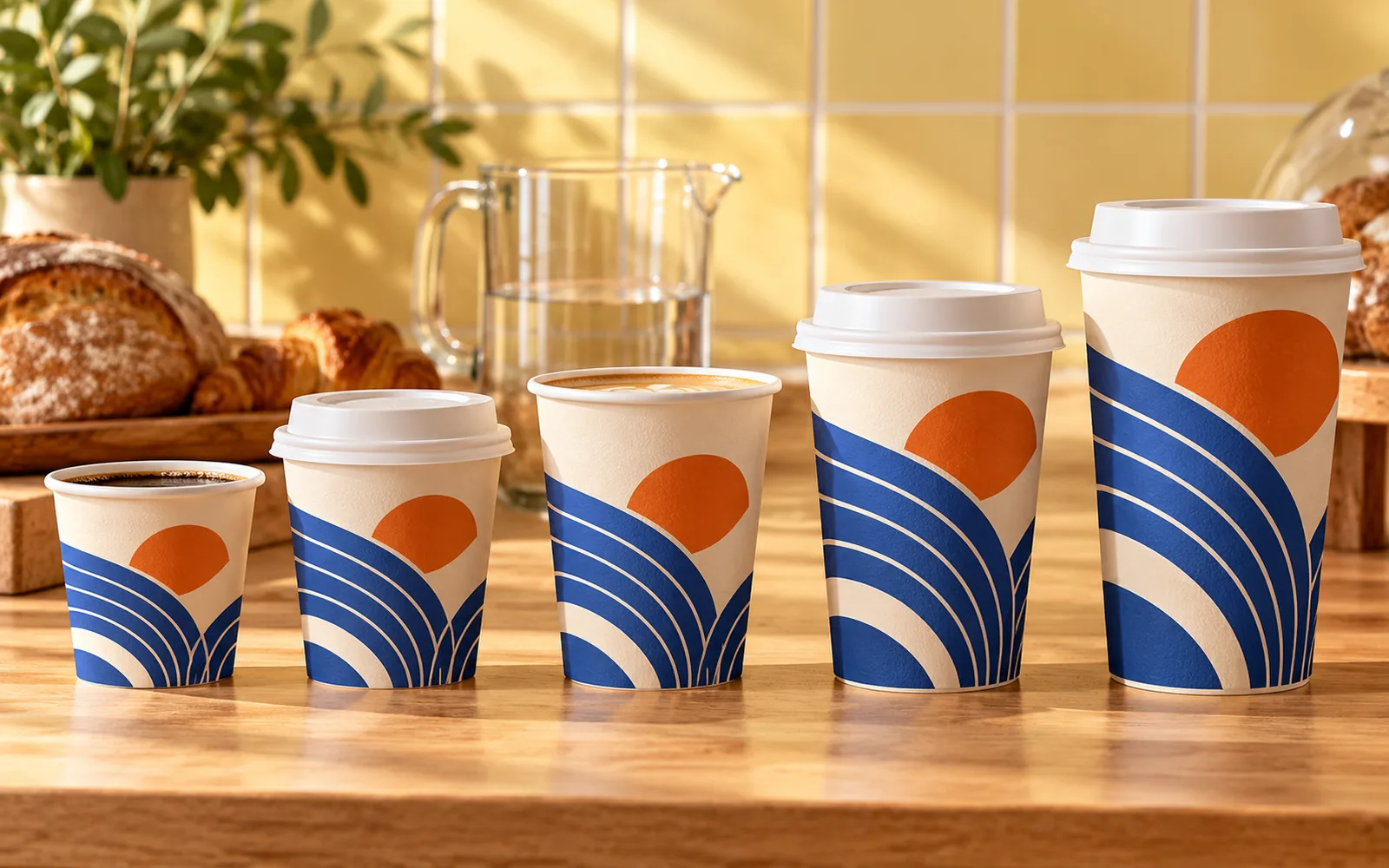
The right-hand column is a menu-planning example, not a drink recipe, an industry-wide “small/medium/large” rule, or a promise that PaperBull sells every listed format. U.K. imperial fluid ounces have a different conversion factor, so specify the unit system when comparing international quotations; NIST lists both U.S. and imperial factors.
What Does a Coffee Cup Size Actually Measure?
Three measurements answer different questions:
- Nominal capacity is the ounce or mL label used to identify a cup size. It is useful for comparing options but is not a complete serving or engineering specification.
- Intended serving fill is the volume of the finished drink your staff will pour. Milk, foam, ice, toppings and room for the lid can change the required headspace. Test the actual recipe in the actual cup.
- Physical geometry includes the rolled rim, body height and base. These determine whether lids, sleeves, carriers, dispensers and artwork fit. PaperBull’s paper-cup dimensions and dieline guide explains why an ounce label alone cannot substitute for the item drawing.
For example, a calculated 12 U.S. fl oz is about 355 mL. That arithmetic does not say that every cup marked 12 oz should be served with exactly 355 mL of coffee, or that every 12 oz lid fits every 12 oz cup. Ask for the nominated product’s capacity definition, sample and approved matching components.
Which Paper Coffee Cup Sizes Should a Café Test?
Start with the menu rather than an assumed universal “standard” size. The following is a trial matrix for takeaway service; adjust it to actual recipes, sales patterns, local expectations and available supplier formats.
| Service need | Size candidates to sample | What to test before selecting |
|---|---|---|
| Espresso or sampling | 4 oz | Portion presentation, safe handling and whether a small hot cup is actually needed |
| Compact hot drinks | 8 or 10 oz | Finished recipe, foam clearance, cup handling and lid fit |
| Main takeaway range | 12 or 16 oz | Two or three top-selling recipes, fill line, lid closure and cup-holder/carrier fit |
| Large-format drinks | 20, 22 or 24 oz, if offered | Whether demand supports another SKU; hot/cold construction, equipment clearance and component availability |
An operator with one or two recipes may need fewer sizes than a chain serving espresso, brewed coffee, milk drinks and iced beverages. A useful first pass is to identify the drinks that truly require a distinct served volume, then sample the smallest set of cups that accommodates them. This is a procurement method, not a claim that one size mix fits every café.
Hot Coffee, Iced Coffee and the Cup Construction
For hot drinks, compare the specified hot paper cup options and decide whether the use case calls for a single-wall cup with a separate sleeve or a double-wall construction. Do not assume wall style alone proves a temperature, leak or handling performance claim; approve the exact sample under your service conditions.
For an iced-drink program, test the finished drink with its ice and intended closure. A cold cup may need a different material, rim, lid or size mix than the hot menu. PaperBull’s cold PET cup category is a separate product route to compare, not evidence that a hot paper cup and cold cup are interchangeable.
Does the Ounce Size Tell You Which Lid Fits?
No. The lid has to match the specific rim and lid profile, not just the number of ounces on the cup. The manufacturer’s Detpak cup-and-lid chart shows different rim families even among cups with the same nominal 8 oz label. That is an example of manufacturer-specific design, not a PaperBull specification.

Ask for an approved cup-and-lid pair, then test closure, drinking opening, transport and stacking with a physical sample. PaperBull’s paper cup lids category is a starting point, but final compatibility must be confirmed for the selected item codes. Check sleeves, carriers and machine dispensers the same way.
A Five-Step Coffee Cup Size Approval Test
- List the actual drinks. Record the finished recipe volume, whether it is hot or iced, and any foam or topping.
- Shortlist nominal labels. Use the oz-to-mL chart only to find sizes worth sampling; do not treat the conversion as a usable-fill test.
- Run a physical pack-out. Make the drink in the sample cup, leave the clearance your service requires, attach its proposed lid and move it through normal service.
- Check the whole system. Test the cup with the holder, carrier, sleeve, dispenser and storage shelf used by the business.
- Approve the exact specification. Record cup code, capacity definition, rim and body dimensions, matching lid code, artwork version and sample. Recheck if any component or production source changes.
For custom artwork, use the supplier’s current dieline for the exact cup rather than scaling a design from another nominal size. The PaperBull dimensions guide shows the measurements and handoff questions involved.
What to Include in a Bulk Cup Inquiry
Send a supplier a concise, testable request:
| Item | Information to provide or request |
|---|---|
| Menu and destination | Hot/iced drinks, intended market and service channel |
| Volume | Intended served drink volume and required headspace—not just a small/medium/large label |
| Cup shortlist | Nominal U.S. fl oz or mL, wall style and any exact existing item code |
| Fit system | Approved lid, sleeve, carrier, cup holder and dispenser requirements |
| Samples and tests | Physical sample, drink pack-out, closure and handling checks |
| Artwork and supply | Print files, current dieline, quantities by size, delivery market and reorder plan |
| Evidence | Any required material or food-contact documentation for the destination and intended use |
Ask the supplier to confirm price, minimum order quantity, production time and compliance documents for the exact quoted project. A generic size chart cannot verify them.
Coffee Cup Sizes FAQ
Is 12 oz always a medium coffee?
No. “Small,” “medium” and “large” are menu labels that can differ among businesses. State the fluid-ounce or mL size on the purchase specification and verify the actual serving fill.
Is an 8 oz coffee cup exactly 237 mL of served coffee?
Eight U.S. fluid ounces convert to approximately 237 mL, but that is a unit conversion. The drink you serve may need room for foam, additions or a securely seated lid. Measure your recipe in the exact sample cup.
What is the standard disposable coffee cup size?
There is no single size that fits every menu. Foodservice ranges include 4, 8, 12, 16, 20 and 24 oz examples, while PaperBull also lists 10 and 22 oz items. Choose the smallest workable assortment by sampling your drinks and checking compatible components.
Can two cups with the same ounce label use the same lid?
Sometimes, but the label is not proof. Request a matched cup-and-lid code and test it. Rim diameter, rolled-edge shape and lid design can vary by manufacturer and series.
Should iced coffee use the same cup size as hot coffee?
Not automatically. Ice and recipe composition change the required space, and the appropriate cold-drink cup and lid may differ from the hot system. Sample both finished drinks before standardizing the range.
Sources and Verification Notes
- NIST Guide to the SI, Appendix B.8 — U.S. and imperial fluid-ounce conversion factors; chart values are rounded arithmetic.
- WebstaurantStore Coffee Cup Sizing Guide — examples of cup sizes offered for foodservice, not a universal PaperBull specification.
- Detpak Cup & Lid Size Guide — manufacturer-specific illustration of multiple rim/lid families.
- PaperBull Paper Cup Dimensions and Dieline Guide — item-level dimension and artwork checks for buyers.
Plan Your Custom Coffee Cup Range
PaperBull can discuss hot paper cups, cold-drink cups, lids and custom printing as a coordinated bulk project. Contact PaperBull with the drinks you serve, the shortlist of cup sizes, intended fill levels, destination market, expected quantity by size, artwork and matching-component requirements. The exact construction, compatibility, documentation, MOQ, price and lead time should be confirmed in the quotation and sample approval.