

PaperBull · Evidence-led buyer guide
Biodegradable Paper Cups: What Buyers Need to Verify
Are paper cups biodegradable? Some products may support a qualified biodegradability or compostability claim, but a paper exterior alone does not establish that the finished cup will break down under its usual disposal conditions. The barrier, adhesives, inks, lid and actual collection route all matter. For a bulk order, ask for evidence on the exact finished cup, not a generic description of paperboard.
The Short Answer: Paper Is Only One Part of the Cup
In the United States, the FTC’s Green Guides summary says an unqualified degradable claim needs proof that the entire product completely breaks down within a reasonably short period after customary disposal. This is a high bar for a disposable cup commonly headed to landfill, incineration or recycling. The words on a listing are therefore a starting question—not the answer.
A beverage cup is a designed system. The paperboard gives it shape, while a liquid barrier and sealed seams help it hold a drink. Printing, adhesives and a separate lid can add more materials. A claim about the paper fiber cannot automatically be applied to the assembled cup or to a cup-and-lid set.
Swipe horizontally to view all columns →
| Buyer question | Why it changes the answer | What to request |
|---|---|---|
| What is the exact cup construction? | Paperboard, barrier, seam and print may follow different end-of-life paths. | Item-level bill of materials and cross-section or layer description. |
| What is the claim actually saying? | Biodegradable, commercially compostable and recyclable describe different outcomes. | Exact proposed wording, conditions and supporting test or certification scope. |
| Does the evidence cover the finished article? | A coated substrate test is not automatically a finished printed cup approval. | Report or listing that matches the sold cup, maker and current formulation. |
| Where will used cups go? | An accepted collection and processing route determines whether a theoretical benefit is realized. | Written confirmation from the local program or processor. |
| Is the lid included? | A cup certificate does not automatically cover a separately supplied lid. | Lid material, fit and separate end-of-life evidence. |
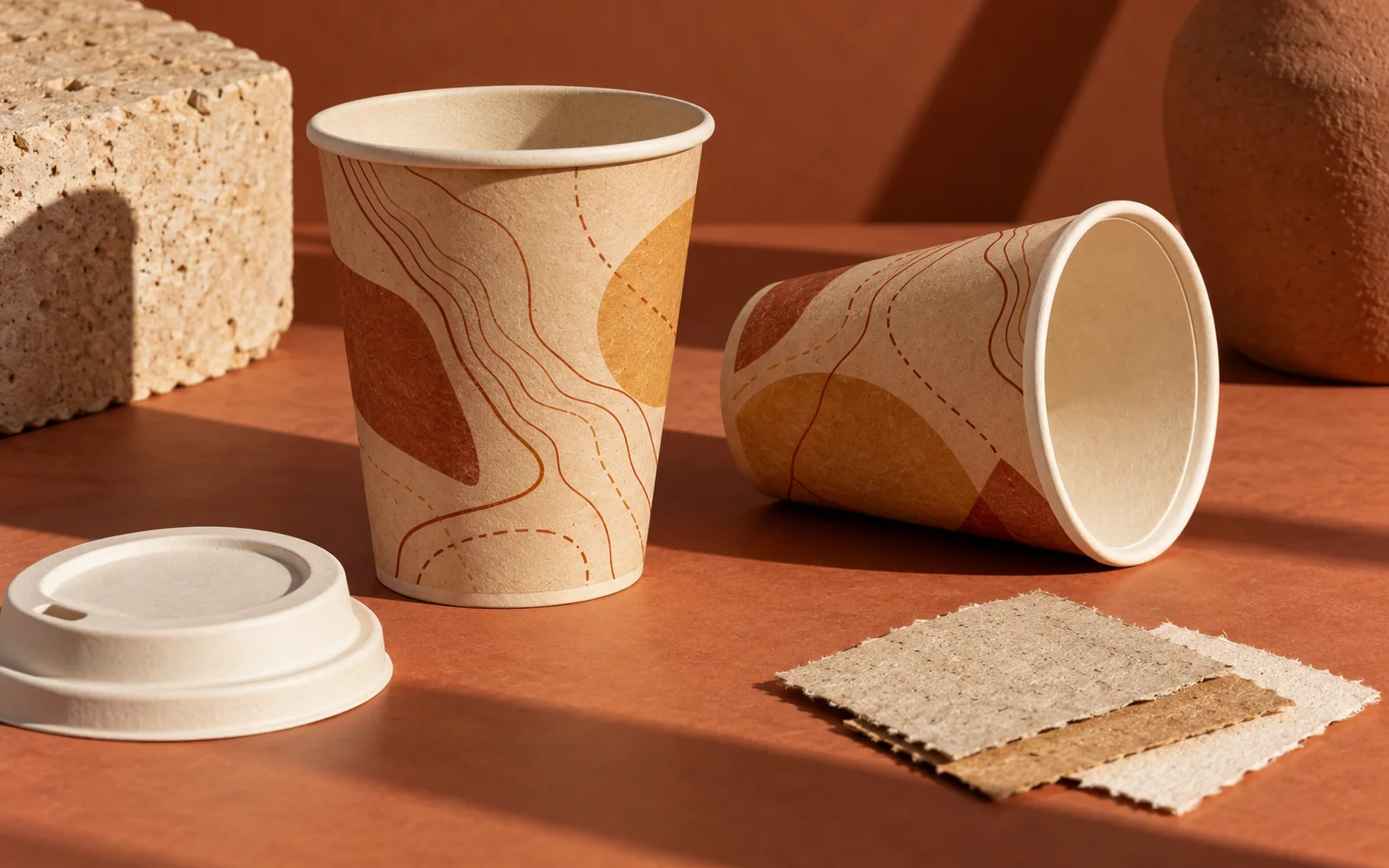
This guide is about making an evidence-based purchasing decision. The cup images are original artwork concepts, not pictures of certified PaperBull products.
Biodegradable, Compostable and Recyclable Are Not Synonyms
Biodegradable describes biological breakdown, but the word by itself omits the conditions, timeframe and destination. Compostable is a more specific claim about breaking down safely within an appropriate composting process. Recyclable is a different route: a used cup must be accepted by a collection and recycling system capable of handling its construction. None of these claims is established by a brown color, a leaf graphic or the word paper.
The FTC says compostable claims need competent and reliable scientific evidence that all materials in the product safely become part of usable compost in roughly the normal composting time. Its guidance also calls for qualification where home composting is unsuitable or commercial facilities are not widely available. See the FTC’s compostable and degradable guidance.
For coated paper items designed for municipal or industrial composting, suppliers may refer to ASTM D6868-21. A reference to a standard is not, by itself, proof that a particular printed cup and lid passed it. Request the scope, report, certificate and exact item identity.
Why the Lining and Finished Construction Matter
Even when paperboard is the largest visible part of a cup, the liquid barrier determines how the cup performs with hot coffee or cold drinks. Coatings and laminates differ, and a material-family name alone does not settle what happens to the finished item after use. A buyer should identify the barrier, seams, adhesives, inks and any applied finish, then match documentation to the actual production sample.
For U.S. food-contact use, the FDA explains that the regulatory status of a food-contact material depends on its individual substances and their conditions of use. An authorization can be specific to a manufacturer and a defined use. FDA’s component guidance is a useful reminder that compostable and suitable for hot drinks are separate questions.
When reviewing a candidate cup, ask whether the evidence covers:
- the exact paperboard and moisture barrier;
- the finished printed and sealed cup, not only a raw material;
- the drink type and intended temperature range;
- the current supplier, factory and formulation;
- any matching lid supplied as part of the order.
For a closer look at barriers and beverage use, see our guide to coated paper cups.
How to Check a Compostability Claim
Use a document trail rather than a generic icon on a catalog page. Start with the exact model number, size and revision of the proposed cup. Ask the supplier whether its claim means industrial/commercial composting or home composting, and which parts of the order are included. Compare the certificate or test report with the approved production sample, including printing and lid options.
The BPI certified-product directory has separate foodservice categories for cups and lids. If a supplier cites BPI, search for the exact current item and manufacturer. A material component listing, a different size or a different lid should not be presented as certification of the entire supplied set.
Swipe horizontally to view all columns →
| Evidence item | Acceptable buyer check | Red flag |
|---|---|---|
| Exact item identity | Model/size/material revision matches quote, sample and record. | A certificate for another cup or only a resin. |
| Claim conditions | Commercial vs. home route and market are explicit. | Biodegrades anywhere with no conditions. |
| Finished construction | Printing, barrier and assembled form are within scope. | Only unprinted base paper tested. |
| Validity | Current listing or dated report from an identifiable issuer. | Cropped logo with no searchable record. |
| Local handling | Processor accepts the exact cup and lid; collection is arranged. | A certified item has no destination after use. |
Can a Local Composting Program Take These Cups?
Certification does not create a collection route. The U.S. EPA’s food-service ware guidance recommends buying certified commercially compostable foodservice ware only when a local commercial program exists, accepts the product type and has collection or hauling in place. It notes that some commercial facilities refuse compostable products.
For a café, venue or campus, confirm the actual receiving facility before placing a large order. Ask whether it accepts lined paper cups, printed cups, lids and food residue; then label bins for the exact accepted items and train staff. Where that route is unavailable, compare reusable service where operationally practical and investigate the local recycling system rather than assuming a compostable item belongs in a recycling bin. Our paper-cup recycling guide covers that separate route.
Choosing Cups for Hot Drinks, Cold Drinks and Lids
Environmental evidence is only one part of a fit-for-use specification. A cup also needs to work with the drink, fill level, handling time and lid system. Do not infer heat resistance from biodegradable, or compostability from paper coffee cup.
For biodegradable paper coffee cups or other hot-drink proposals, test the filled cup at the intended service temperature for seam integrity, stiffness, handling comfort, taste/odor and the matching lid fit. For cold drinks, test condensation, softening, bottom seal and the expected time in use. Record the actual conditions and acceptance limits; a visual sample alone cannot confirm performance.
If the order includes lids, obtain the lid’s own composition, food-contact evidence and end-of-life claim. Cup and lid may require different routes. The PaperBull hot paper cups range is a starting point for discussing dimensions and print requirements; any biodegradability or compostability specification must be separately confirmed for the exact project.
Compare Quotes With a Cup Specification Matrix
Ask each supplier to complete the same specification fields for each proposed cup and lid. An 8 oz cup label alone does not establish fill line, rim diameter, lid compatibility or construction. A comparable specification makes sampling, pricing and document checks easier.
Swipe horizontally to view all columns →
| Specification field | What the supplier should state | Why a bulk buyer needs it |
|---|---|---|
| Item identity | Manufacturer, factory, model or SKU, size and formulation revision; separate lid SKU. | Ties the quote, sample, report and later production order to the same item. |
| Dimensions and fill | Nominal volume, intended fill volume, top and bottom diameter, height and stated tolerances. | Checks menu portion, dispenser, carrier and lid fit. |
| Cup construction | Single-, double- or other wall style; paperboard specification; barrier/coating, seam, adhesive and print components. | Identifies the complete article behind an environmental or food-contact claim. |
| Intended beverage use | Hot or cold drinks, relevant food type and the supplier’s supported use conditions. | Prevents a cold-cup document being assumed to cover hot coffee. |
| Matching components | Lid model, material, fit basis, sleeve and carrier compatibility where required. | A cup and lid are separate pieces with separate evidence and supply risk. |
| Print specification | Printable area, artwork template, color method, print coverage and approval proof. | Allows comparable artwork and tooling quotes. |
| Pack-out | Pieces per sleeve and carton, carton dimensions and gross weight, pallet configuration if offered. | Supports warehousing, freight and landed-cost comparison. |
| Documentation | Food-contact basis for the destination market; exact environmental-claim wording and item-level report or listing. | Shows whether the proposed finished cup can support the intended use and claim. |
If a formulation is confidential, request an appropriate item-level declaration and supporting evidence through the supplier’s normal documentation process rather than substituting a vague marketing label. For U.S. food-contact review, FDA guidance makes clear that component status and conditions of use matter.
Approve a Sample Before the Bulk Run
The approved reference should be the same construction that will be mass-produced, including coating, printing and lid pairing. A practical approval sequence is:
- Identify the sample. Label its model, size, construction revision, print proof and matching lid SKU so it can be compared with the quote and evidence package.
- Measure the fit. Check cup dimensions, fill line, stackability, dispensing and lid seating with the equipment used at the intended site.
- Test the real service. Record beverage type, starting temperature, fill level, handling time, orientation and observations for seams, leakage, stiffness, comfort and lid retention. Set pass/fail criteria before testing; no universal performance duration follows from the word
biodegradable. - Match the documents. Confirm that food-contact documents and any environmental report or certification identify the approved item and intended conditions. Search an exact certification listing where one is claimed; the BPI directory lists cups and lids separately.
- Lock change control. Keep an approved physical sample or documented reference, and require notice and review before material, coating, print, factory or lid changes. Define the inspection points for the bulk order.
These are procurement checks, not a statement that a PaperBull cup has already passed them. Ask the supplier for the test method and result if a performance claim is important to your project.
Compare MOQ, Price and Delivery on the Same Basis
The lowest unit price is not necessarily the lowest delivered cost. Request written commercial terms by size, construction and print version so quotations are comparable. The table below lists fields to obtain; it does not state PaperBull’s current terms.
Swipe horizontally to view all columns →
| Commercial field | Ask the supplier to specify |
|---|---|
| Minimum order | MOQ per size, artwork and construction; whether cup and lid minimums differ. |
| Price breaks | Unit price at the requested quantities, currency, quote validity, applicable taxes and whether lids are included. |
| One-time charges | Sampling, artwork setup, printing plates or tooling, and charges for later revisions. |
| Timeline | Proof approval, sample production, bulk production and shipping stages; what starts each clock. |
| Freight basis | Quoted Incoterm and destination, carton count, dimensions, weight, pallet or container information, and separately charged freight. |
| Supply controls | How substitutions, production changes, shortages and nonconforming cartons will be handled. |
When comparing options, calculate the same landed-cost basis and include the cup, lid, setup and freight that the project actually needs. Do not place an environmental claim on artwork until the exact item and destination route have been verified against the claim. The FTC’s Green Guides summary explains why broad or unqualified environmental claims require particular care.
A Bulk-Buyer Request List
Before requesting biodegradable paper cups in bulk, send a brief that allows the supplier to quote an identifiable construction rather than a vague green label:
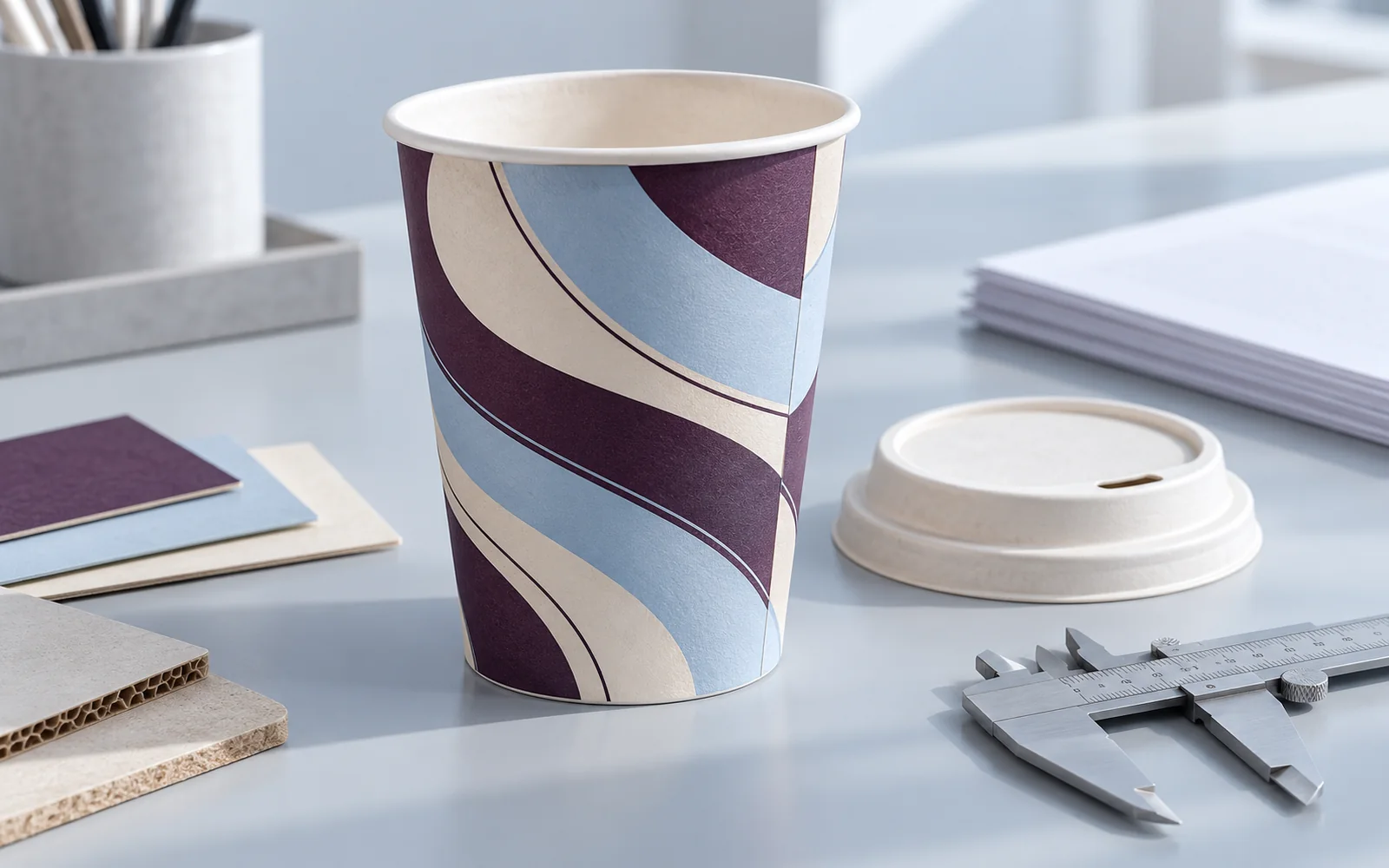
- Cup use: size and intended fill, beverage, hot/cold service conditions, wall style and expected handling time.
- Components: matching lid, sleeve, carrier or dispenser requirements, including any existing equipment dimensions.
- Construction and artwork: preferred barrier, print coverage, colors, artwork format and whether a dieline is needed.
- Claim and destination: exact environmental wording under consideration, destination market and the intended local collection or processing route.
- Evidence: item-level environmental record, food-contact basis and any buyer-specific document or test requirement.
- Samples: sample quantity and the service conditions and pass/fail criteria you plan to check.
- Commercial brief: estimated order quantity by size/artwork, delivery location, target schedule and requested quote basis.
Ask the supplier to respond with a written construction sheet, matched cup-and-lid options, the applicable item-level documents, a sample and artwork approval path, MOQ by version, itemized price breaks, pack-out and delivery terms. If any field is not yet confirmed, keep it open in the quote rather than converting an assumption into a website claim. Printing and artwork discussions can proceed separately from environmental-claim approval.
Frequently Asked Questions
Are all paper cups biodegradable?
No universal answer follows from the paper label. The finished cup can include a barrier, inks, adhesives and other materials; the disposal condition and evidence determine whether a particular claim is supportable.
Are biodegradable paper cups the same as compostable cups?
No. Compostability is a defined claim about an appropriate composting process and the whole product. A broad biodegradability statement does not identify the facility, conditions or timeframe.
Can I put a commercially compostable paper cup in my home compost bin?
Not on the basis of a commercial-compostability claim alone. Check whether the exact item is supported for home composting and follow local program guidance. Commercial certification and home composting are different use conditions.
Are paper cups with a barrier coating recyclable?
It depends on the construction and the local recycling program. Recycling is separate from compostability; check your receiving recycler rather than relying on a generic icon. See our paper-cup recycling guide.
Do biodegradable paper cups with lids use the same disposal route?
Not necessarily. A lid is a separate article and should have its own material, food-contact, fit and end-of-life evidence. Confirm that the receiving program accepts both pieces.
What proof should a wholesale buyer request?
Ask for a construction sheet, the exact claim wording, current item-level test or certification record, food-contact documentation for the intended beverage use, a matched production sample and confirmation that the local processor accepts the item.
Sources and Verification Notes
- FTC: Environmental Claims — Summary of the Green Guides — U.S. biodegradable/degradable and compostable marketing-claim qualifications.
- U.S. EPA: Identifying Sustainable Food Service and Food Service Ware — procurement and local commercial composting route.
- ASTM: D6868-21 catalog — scope for coated paper end items intended for municipal or industrial composting.
- BPI: Certified-Product Directory — item-level product search; cups and lids are separately listed.
- FDA: Regulatory Status of Food-Contact Components — material and intended-use evaluation.

About the author
Vincent Zheng
Vincent Zheng is the Co-Founder and Sales Manager at PaperBull, with five years of experience in the packaging industry. He works with bulk buyers on cup selection, custom printing, sample matching and supply requirements for foodservice packaging.
Ready to specify the exact cup?
Discuss a Documented Paper Cup Project
If you need a cup with a particular end-of-life claim, contact PaperBull with the intended size, beverage, print design, destination, quantity and collection route. We can discuss a project-specific specification and the documents that must be checked before any product or environmental claim is used. Material construction, food-contact status, certification, availability, MOQ, price and lead time remain subject to confirmation for the exact quotation.