
Cafe takeaway & delivery packaging
Take Out Cup Solutions for Cafes and Delivery
A take out cup is only one part of the handoff. Choose the cup, lid, carrier and printed design together, so your drink menu and service workflow shape the specification.
Original AI-generated design concept shown. Final materials, fit and artwork require sample approval.
Hot, iced or topped
Material and working fill
Approved model and fit
Carrier, artwork and service
Start with the menu
Choose a Take Out Cup System
For cafes, restaurants and beverage brands, the useful question is not simply “paper or plastic?” It is which cup-and-lid combination suits the drink, the customer journey and the documentation your market requires.
Paper Hot Cups
Start with a hot-drink paper cup and specify the intended beverage and filling conditions. Discuss single-wall, double-wall or ripple-wall options rather than treating every paper cup as interchangeable.
If you are comparing an outer wall with a separate sleeve, test the full serving arrangement. Wall count alone does not establish a safe touch temperature or a heat-retention time.
Explore paper hot cups →Clear Cold Cups
For an iced coffee, juice or layered drink, consider a clear cold-cup system when seeing the beverage matters. Compare the exact cold-use cup model with flat, sip or dome lid options approved for that model.
Do not extend a cold-cup specification to hot filling. Confirm intended-use limits and food-contact documentation for the actual material and destination.
Review clear PET cold cups →Printed Cup Families
A coherent take out coffee cup range can connect several sizes through one recognizable design. Keep size labels and order marks readable, and reserve a consistent brand area that works on the smallest cup.
Confirm the actual cup construction first. A design that looks convincing in a render still needs a supplier-issued dieline, artwork review and a physical print proof.
Compare original design directions →Planning reusable take out coffee cups? Treat them as a separate operating program, with collection or customer-return rules, washing responsibilities and product-specific reuse instructions. A disposable paper-cup specification does not cover those requirements.
Capacity before appearance
Match Size to Working Fill
Use menu portions to shortlist sizes, then fill physical samples using the real recipe. A nominal capacity is not a complete specification for drink yield, external dimensions or lid compatibility.
| Menu or service need | Starting point to discuss | Check on a filled sample |
|---|---|---|
| Short hot drinks | A smaller hot-cup option, such as an 8 oz menu size | Recipe yield, headspace and sip-lid clearance |
| Core coffee menu | A 12 oz or 16 oz option where it matches your recipe | Working fill, cup height, grip and dispenser fit |
| Iced coffee or tea | A cold-cup model sized around liquid plus ice | Ice volume, fill line, lid opening and condensation handling |
| Cream or other toppings | A compatible lid with sufficient clearance | Topping height, closure contact and the customer’s drinking method |
| Multi-drink delivery | Approved cups and lids tested with the chosen carrier | Base support, cup movement, loaded balance and bag clearance |
Write Down the Dimensions
Record nominal capacity, intended serving fill, top-rim diameter, base diameter and overall height. Ask whether a quoted capacity is measured to the brim or to a working fill. Small, medium and large are menu labels, not manufacturing dimensions.
Keep the Range Practical
Fewer approved cup-and-lid combinations can simplify a stockroom, but only where the supplier confirms compatibility. Do not assume that two cups sharing an ounce label, or even a nominal rim diameter, accept the same lid.
The complete handoff
Take Out Cups with Lids
Buy a matched system, not a cup and an approximately sized cover. Specify the exact cup SKU, lid SKU, rim profile, material and intended beverage conditions before approving a bulk order.
Check the Closure
Ask for the supplier-approved pairing and inspect samples around the full rim. In a controlled trial, follow the supplier’s handling instructions and check lid seating, removal, sipping and movement during your normal service route.
An open sip hole means a fitted lid is not a sealed bottle. Do not promise leakproof delivery without product-specific evidence under the stated conditions.
Start with the cup lids range, then verify the exact pairing.
Test the Cup Carrier
For take out cup carriers, check the cup base and taper against the carrier wells. Trial the intended number of filled cups, including mixed sizes when customers commonly order them. A carrier that holds an empty cup may behave differently under a full order.
Include counter pickup, walking, bag placement and the handoff to the delivery driver. Record tipping, movement and lid contact; agree acceptance criteria before ordering. Do not infer carrier strength from an attractive product image.
Send your drink list, fill volumes, cup and lid codes, typical number of drinks per order, carrier requirement and delivery method. Ask for the combination to be confirmed in writing.
Three original visual directions
Make the Cup Recognizable
A custom take out cup should be recognizable when held, stacked or placed in a carrier. These fictional concepts explore distinct graphic systems and settings; they are AI-generated design studies, not customer projects, stock-product photographs or print-ready files.
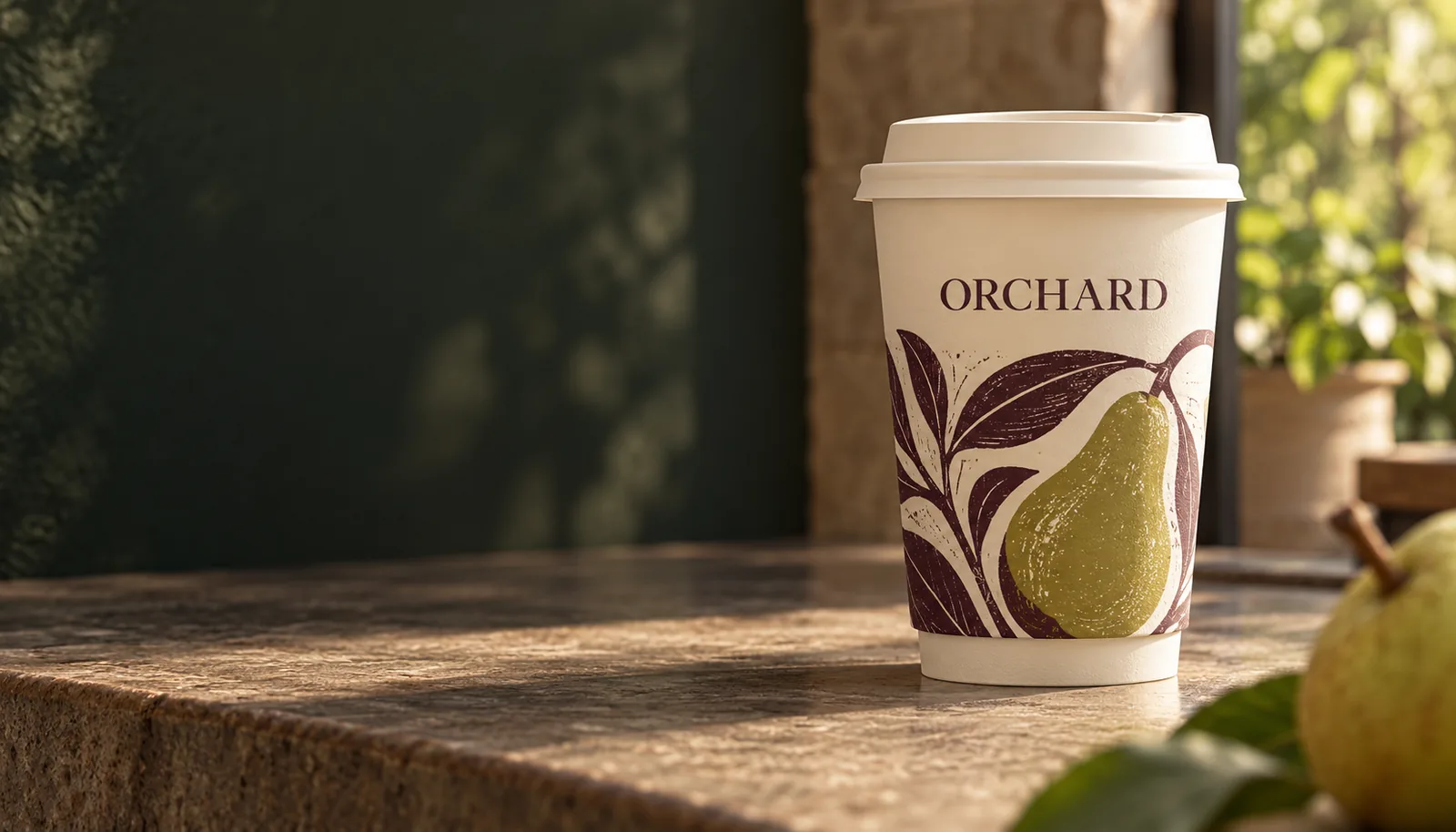
ORCHARD
Warm ivory, aubergine and a carved pear create a single visual focal point. A compact serif wordmark balances the large artwork. The morning cafe scene reinforces the fruit-led identity.
Why choose it: a clear motif with room for seasonal fruit variants. Proofing focus: ink coverage and contrast on the selected paper.
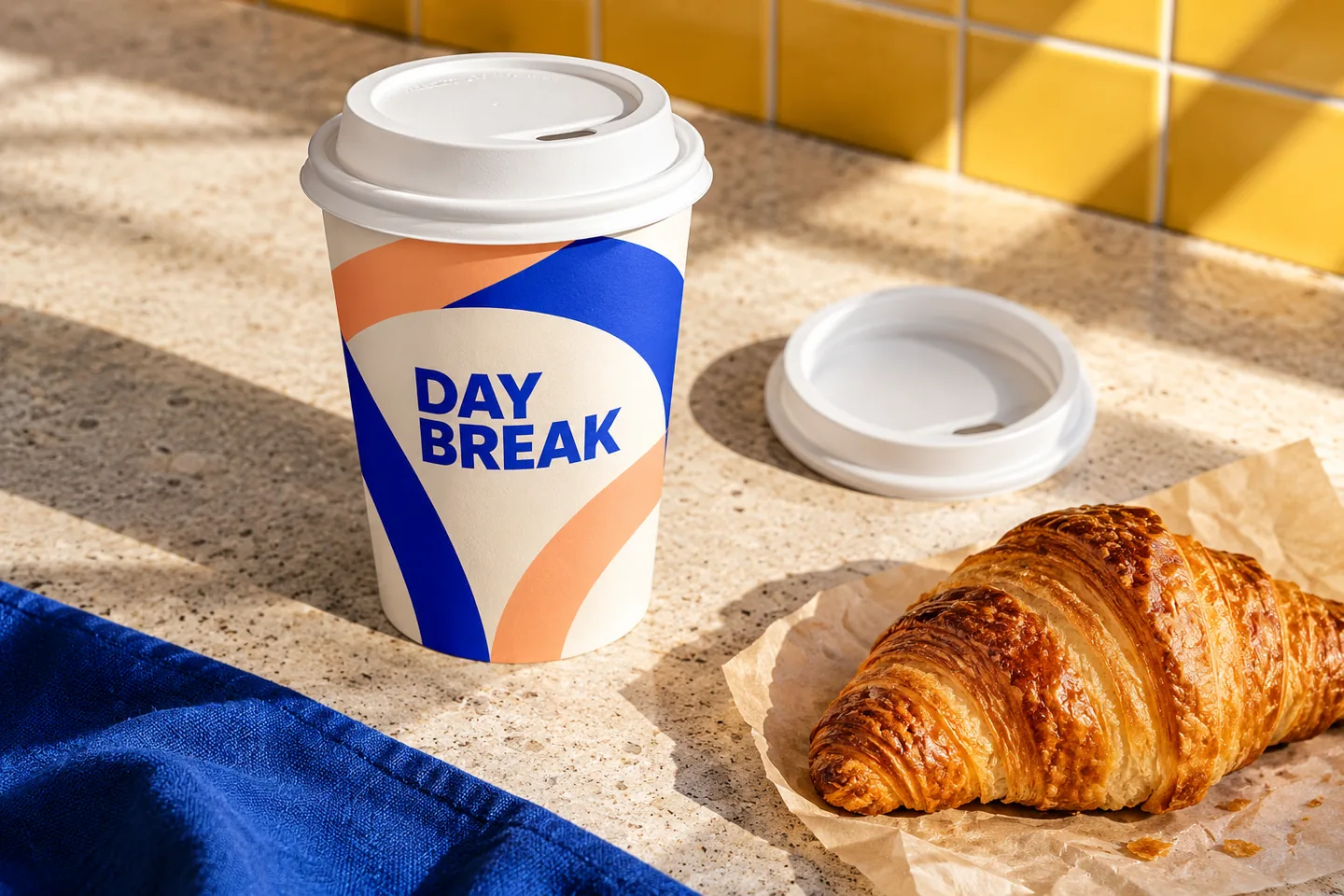
DAYBREAK
Oversized cobalt and apricot ribbons frame a stacked wordmark. A high-angle bakery composition gives this concept a brighter, more energetic character than a conventional botanical cup.
Why choose it: strong recognition at counter distance. Proofing focus: wrap alignment, seam placement and legibility across sizes.
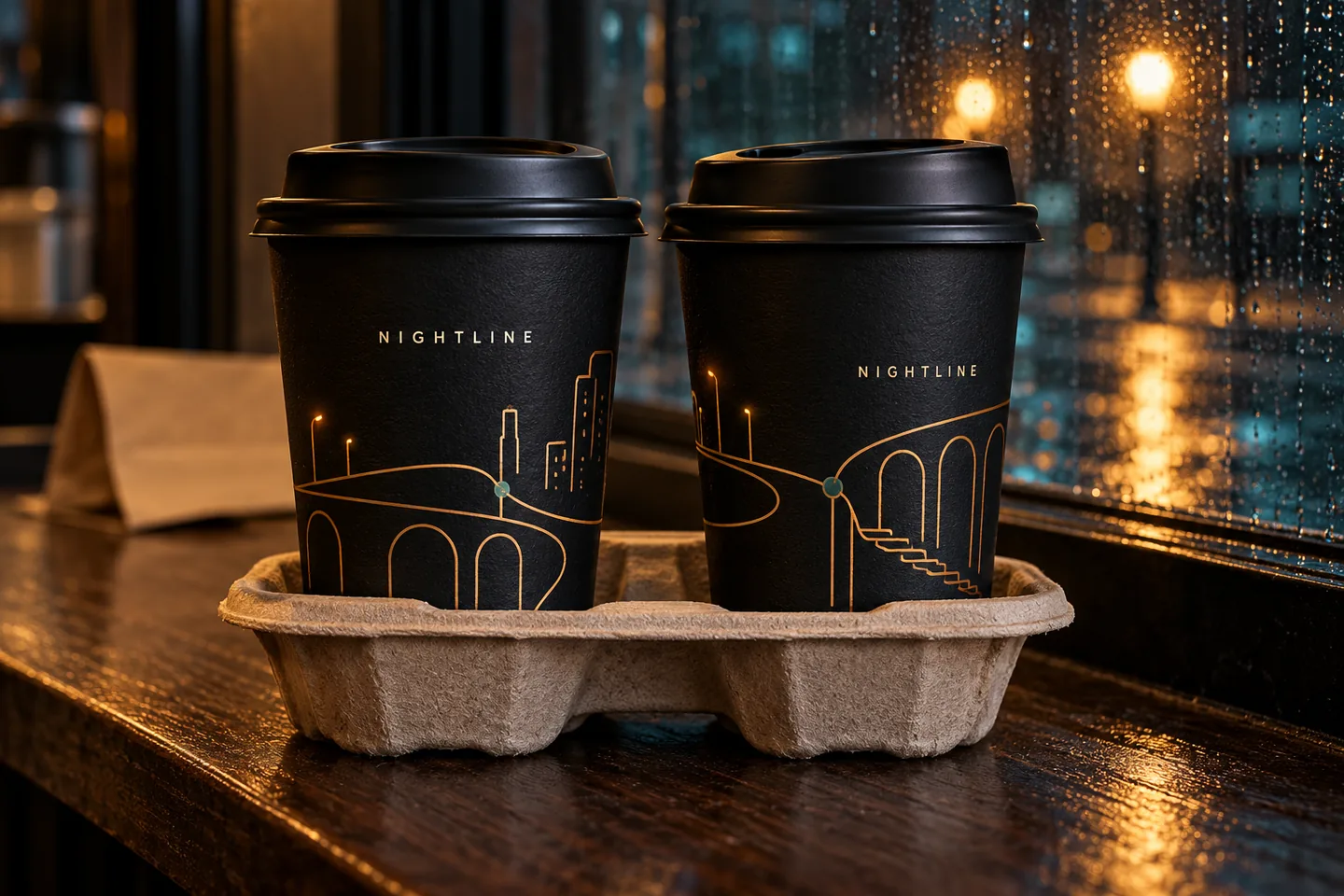
NIGHTLINE
Fine amber routes and a small cream wordmark connect two dark cups in a delivery setting. Equal-size cups in a carrier show how a graphic system can work across a complete order.
Why choose it: a cohesive evening-service identity. Proofing focus: fine-line contrast and whether any special finish is technically and commercially suitable.
Our visual recommendation: ORCHARD. Its large motif stays clear without relying on tiny copy, and the calm negative space works well in a banner. The trade-off is that dark ink areas need careful proofing. For production, replace the fictional wordmark with approved brand assets and use the exact cup dieline.
From concept to purchase brief
Prepare a Clear Bulk Order
Request a quotation against a written specification. This helps separate artwork decisions, sample testing and commercial terms, instead of treating a photo or a generic “food-grade” description as approval.
Your RFQ Checklist
- Drinks, recipes, serving fill and intended filling conditions
- Cup construction, lining or coating, dimensions and approved lid code
- Carrier, sleeve, dispenser and delivery-bag requirements
- Destination market and relevant food-contact documentation
- Artwork files, print colors, dieline, seam and proof approval
- Order quantity, case pack, destination and required delivery date
- Separate prices for cups, lids, carriers, freight and setup where applicable
MOQ, lead time, price and available finishes must be confirmed for your project. No fixed commercial terms are implied by this page.
Ask for the Right Evidence
Request food-contact information for the actual cup, coating, ink and lid, as relevant to the intended use and market. A material name or a general supplier statement is not a substitute for product-specific documentation. The FDA food-contact inventory explains that authorizations relate to identity, intended use and conditions; it is not a blanket approval of every finished cup.
For recycling, check acceptance with the receiving local program for both cup and lid. A resin code alone does not guarantee local collection, as the EPA recycling guidance explains.
Avoid unqualified “eco-friendly” language. Any compostability or similar claim needs relevant evidence and clear qualifications; see the FTC Green Guides summary.
Define
Agree the menu, serving conditions and target market.
Sample
Check the complete cup, lid and carrier combination.
Proof
Approve the actual dieline, print proof and specification.
Confirm
Record commercial terms and production acceptance criteria.
Review PaperBull’s custom printing process when preparing artwork, or explore the broader packaging solutions for related service formats.
Common buyer questions
Take Out Cup FAQs
Practical answers for matching your service needs to a purchasing specification.
What is a takeaway coffee cup called?
Common names include a takeaway coffee cup, to-go coffee cup or take out coffee cup. For purchasing, add the material, wall construction, nominal capacity, dimensions and lid code so the wording identifies a specific product.
Where can I buy takeaway coffee cups?
Foodservice distributors and packaging suppliers offer disposable coffee cups. For a branded cafe or delivery program, send PaperBull your drink menu, quantity, destination and lid requirements to discuss a suitable specification and sample route.
Where can I find takeaway cups with lids?
Ask a cup supplier for a documented cup-and-lid pairing, not just two products with matching size labels. Confirm the exact model codes and test samples under your intended serving and transport conditions before ordering in bulk.
Are take out coffee cups recyclable?
There is no universal yes. Acceptance depends on the cup’s construction and the receiving recycling program. Check the cup and lid separately, use local collection instructions and do not assume that a paper appearance or resin code proves recyclability.
Do I need a carrier for every takeaway order?
Not necessarily. Base the decision on drink count, walking or delivery conditions and how the customer will carry other items. For multiple drinks, test the filled cups in the intended carrier and bag rather than relying on the empty fit.
Verification notes
Sources and Scope
The buyer workflow is editorial guidance. Government references support the limited food-contact and environmental points above; they do not certify the illustrated cups.
- FDA: food-contact substance inventory and conditions of use
- EPA: how to recycle common materials and check local acceptance
- FTC: environmental marketing claims and the Green Guides
Images are original AI-generated packaging concepts using fictional demonstration names. Materials, printing finishes, thermal performance, leak resistance, compatibility and environmental claims require separate product-specific verification.
Build the whole handoff
Plan Your Take Out Cup Program
Share your drinks, serving sizes, estimated quantity, artwork, destination and delivery method. Discuss cup, lid and carrier requirements together before choosing a final specification.
Discuss Your Cup Project
Share the drinks, quantity, destination, lid requirements and timing.